Seattle Times columnist Nicole Brodeur on What’s Next for The Mountain’s Marty Reimer.
http://mobile.seattletimes.com/story/today/2019939117/track-ip_news_lite-1.2.2-./
Seattle Times columnist Nicole Brodeur on What’s Next for The Mountain’s Marty Reimer.
http://mobile.seattletimes.com/story/today/2019939117/track-ip_news_lite-1.2.2-./

Since last Friday, more than 1,900 of you have watched The Marah Project video. If everyone who’s watched would give just $2.00 (that’s it … 2 bucks) we’d have enough for two full internships with Teens for Public Service. Since this summer when the internship program was set up, more than $22,000 has been raised for The Marah Project.
As many of you know in June, Seattle TV personality Penny LeGate’s daughter, Marah Williams, lost a long battle with drug addiction and depression. From loss comes new outreach and this short documentary aimed at raising awareness and funds for an internship in Marah’s name. Take a few minutes and watch this video I produced with Penny and Mike Williams’s gracious help. They were remarkably open and willing to share in the hopes that something good might one day come from Marah’s passing. Perhaps it will. Perhaps you’ll contribute. We hope so.
http://www.teensinpublicservice.org/get-involved/the-marah-project/
On Monday, watch KING 5’s Evening Magazine for their feature about The Marah Project. Penny LeGate co-hosted the show with Brian Tracy for nine years in the 90’s. “Evening Magazine” airs at 7:00pm Monday on KING 5 (NBC in Seattle). Don’t miss it.
A powerful story told by a gifted writer, National Public Radio’s John Burnett.
Life is cheap where hope is scarce. And here in Nairobi’s Huruma slum you have to look hard to find any hope. So much is discarded here; bottles, cans, tires, plastic but mostly people.
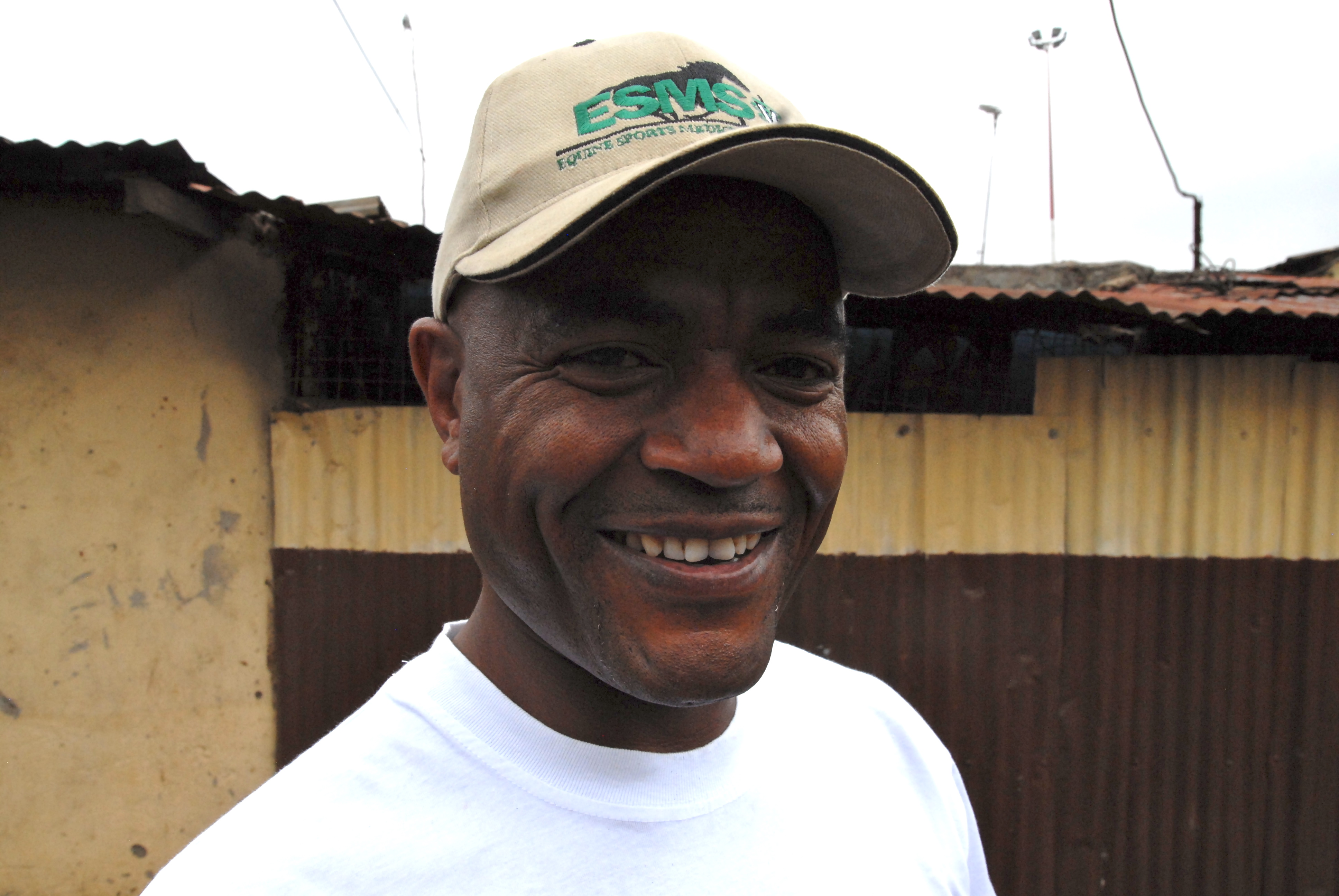
42 year-old John Kangara Mucheru knows this. He’s lived in Huruma all his life. But Mucheru looks for use in everything. The word Zakale means “re-use” in Swahili, the cultural language of Kenya. And that’s exactly what he’s done with bottles, cans, tires, plastic but mostly people.
People like 28 year-old Milton Obote. Ten years ago, Milton was playing pick-up soccer, smoking marijuana and burglarizing homes. Until he met John Mucheru. While watching a Humura pick-up soccer game Milton and his friends were playing, Mucheru noticed the artistry with which Milton played the game. “Futbol (soccer) is what I eat”, says Obote. But John Mucheru didn’t like the company Obote kept. He saw something special in the teenager that everyone else had overlooked. If they even looked at all.

The two started talking. John challenged Milton to do something with that artistic side. He gave the teen a piece of wire and asked him to “design something.” Obote brought back a beautifully created hand. Soon, John invited Milton to work for him at Zakale Creations, based right here in Huruma. He knew Milton and didn’t like to see boys like him waste their lives. Perhaps he saw a little bit of himself.

John used to be involved in gangs, petty theft, some robbery. “It wasn’t my wish”, says Mechuro. “I had no alternative.” In a place like Huruma you do anything to survive. Something happens to a person when you’re packed into a place of extreme poverty with 60,000 others. The word Huruma in Swahili (one of Kenya’s official languages) means, sympathy. Some who live here think Huruma is just another word for “madhouse”.

Mucheru doesn’t remember anything good about Christmas as a child. No fond memories. “I never got a Christmas present. I was orphaned when both my parents died when I was three.” Today, John Mucheru is turning that around. Today, the ornaments his young men and women at Zakale Creations make are sold to a company called Heavenly Treasures. That company in turn, sells them to World Vision where they are offered in the charity’s Gift Catalog.

Now each Christmas, John Kangara Mucheru throws a big party for hundreds of his neighbors in Huruma. “Christmas is time for sharing what you have with those who have nothing,” says Mucheru. His young men and women welcome visitors with a ceremonial dance.
They are energetic, happy and appear full of hope. And today, Milton Obote is married with a young daughter and hopeful he can land more design work.
“Zakale Creations,” Mucheru says, “is about creating new life.” What better time of year to find that new life in the discarded bottles, can, tires, plastic but mostly people. Here in the maddening heart of despair, John Mucheru has found a way to deliver a tiny piece of hope.

Zakale Creations employees
welcome visitors in song and dance

Mindy Mizell – World Vision
on reliable transportation
“The impact of Sandy will be felt for months if not years to come.” Yet New York’s Mindy Mizell knows that this will be a big story in the media for only a matter of weeks, at best. She says “We need to remember that there are going to be people who still need our help whether we still see this on the news or not.”
In other words – while the compassion “window” will only be open so long – the needs of those hard-hit by Sandy will remain.
And as the media coverage for Sandy’s aftermath begins to fade, a few images linger for Mizell.
“The streets were packed with cars and taxis. People had to stay above ground with the subways still closed,” Mizell says, “The only reliable way I had to get to work was my Piaggo, scooter.” Mizell lives in New York with her husband, Travis Galey, who works for CBS News. Mindy is World Vision U.S. Media Relations Director. Mizell says, “God has a way of putting me in the right place at the wrong time.”
When she says the “wrong time” she means when she’s assigned to a natural disaster.
Mizell has been Media Relations Director at World Vision since 2010. Her news career has taken her from Roswell, New Mexico to Baltimore to Washington, D.C. to Oklahoma City. Since she joined World Vision and “re-purposed” her journalism, Mindy Mizell has traveled all over the world hoping to draw reporters’ attention to issues like hunger, malnutrition, extreme poverty and natural disasters. But last Monday morning she was at home in Manhattan when the natural disaster came to her.

Damaged Relief Supplies
World Vision South Bronx Storehouse
Relief supplies in the South Bronx Storehouse were damaged by Sandy before staff ever got to deliver them. Flood waters from the nearby East River destroyed dozens of boxes of relief supplies.
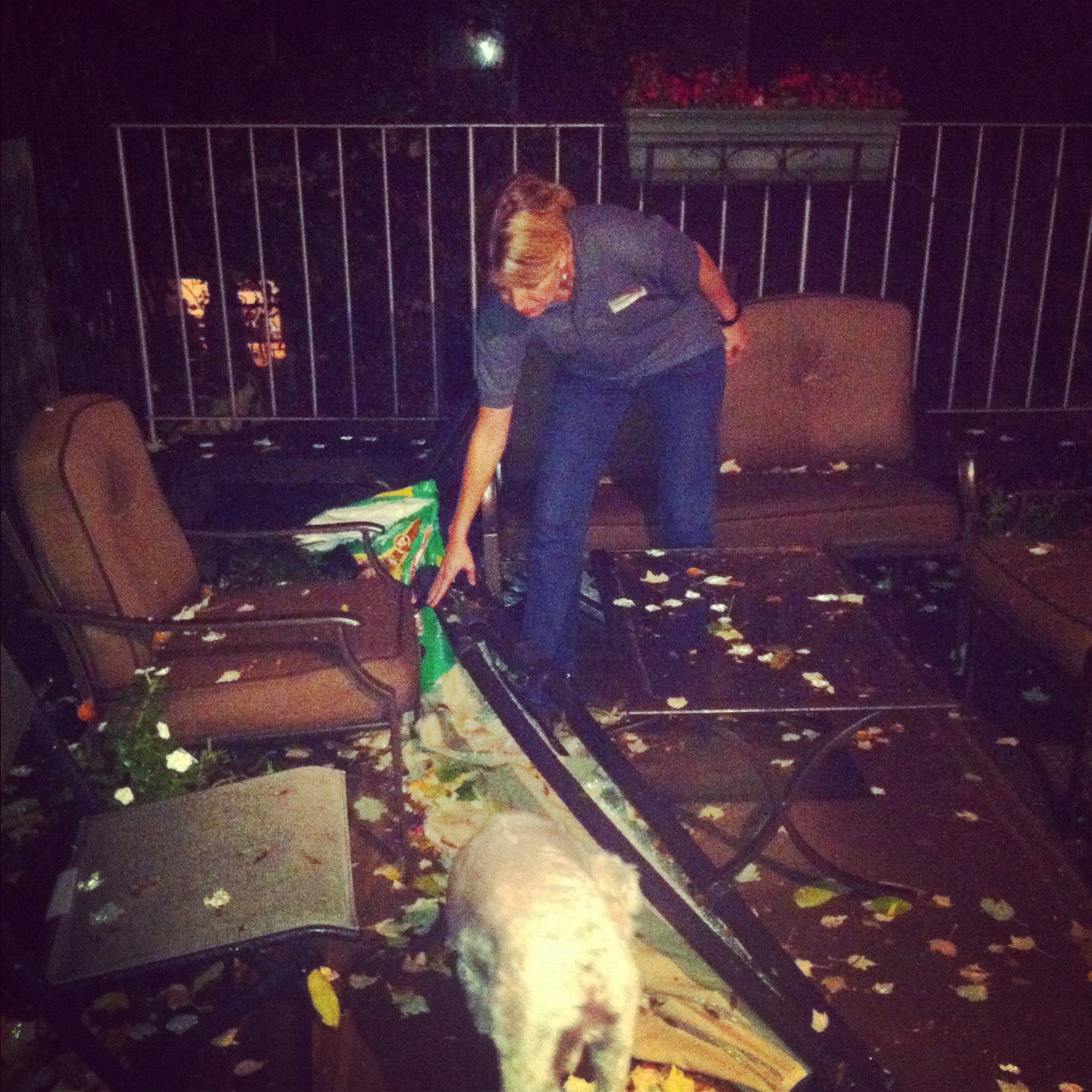
Mizell cleaning minor damage
Manhattan – Upper West side
Mizell admits she was lucky. While at this writing, thousands are still without power, she says the lights at her home only flickered a few times. Damage to their apartment was confined to blown down branches.
She and Travis live on Manhattan’s Upper West Side, the upper left side of this now-famous picture in the current issue of New York.

But Mizell hasn’t been home much to notice. In the last two weeks Mindy has done dozens of interviews for local, national and international media, working 12-14 hour days. “We had so many media requests that my phone died while in transit and I had to charge it with the BBC crew in their cars while I did the interview.”

But again Mizell says she was lucky. Instead of broken windows and downed trees she just came home to her Schnauzer, Brinkley.
World Vision is an international Christian relief and development organization based in Federal Way, WA.
Update to 9/27 post.Microsoft’s Margo Day selected as Geek Wire’s Geek of the Week
http://www.geekwire.com/2012/geek-week-microsoft-education-exec-margo-day-impact-kenya/
If you could take a year off of work how would you change the world?

Margo Day
Margo Day just spent the last year of her life answering that question. The Microsoft VP used a year-long sabbatical that just ended to empower 17,000 girls in rural Kenya to stay in school and avoid the all-too-common cultural practice of early marriage.
Early and or forced marriage and female genital mutilation are still widely practiced in rural Kenya. However, Day is helping to turn the tide. The World Vision Kenya Child Protection and Education Program is focused on accelerating that change.
Access to education is fundamental.
Day took a whole year off work as a high-powered tech VP in order to slow down and help girls living in extreme poverty in a remote region of rural Kenya. She’s just returned from another trip to Africa, her fourth.
Margo Day’s Tips: How to Make a Difference
1. Work with an experienced organization with sustainability at its core.
2. Concentrate your efforts on just one thing.
3. Show others what you’re doing. They want to have that same kind of impact that you have.
4. Listen to God because he’ll tell you when what you have is enough.

The total project budget for the Kenya Child Protection Program is $4.8 million. To date, Day has contributed $150,000 towards the first project, St. Elizabeth Girls Secondary School, which had a total budget of half a million dollars. In addition, she’s now made a commitment to give another $500,000 over the next 3 years towards the Kenya Child Protection and Education Program, for a total of $650,000.

http://en.gravatar.com/margoday
Margo is partnering with World Vision to address issues related to girls’ education and child protection, recently completing construction of the St. Elizabeth’s Secondary School for Girls in West Pokot, Kenya.

Sook Integrated Program Area: Education improvements from 2009 to today: Margo Day says a lot has been accomplished to form a good foundation for the work now of the Kenya Child Protection and Education Program. Here are some education statistics from 2009 to today:
She’s been honored for her work on behalf of women at Microsoft, earning its 2006 Most Inspirational Woman award. She lives in the Seattle, area and loves being outdoors. She enjoys backpacking, boating, cycling, scuba diving, skiing, golf, adventure travel and, when it’s rainy outside, attending concerts and theater in addition to enjoying a great glass of wine.
Important Dates: October 11th – International Day of the Girl
The New Face of American Poverty
A new documentary to be released next month highlights our nation’s poverty. Hear from a Chicago woman about how World Vision helped her family overcome a culture of violence and hopelessness.

(Sheila Howard – photo Midgett Productions)
When Republican presidential nominee Mitt Romney portrayed Democratic President Barack Obama’s supporters – as 47 percent of the electorate – who live off government handouts and do not “care for their lives, ” Chicago’s Sheila Howard took it personally.
“Poor people I know don’t feel entitled”, says 54-year old Sheila Howard from Chicago’s West Side. Howard says, “People forget that there but for the grace of God go I.”
Howard is one of those featured in the new Linda Midgett documentary, “The Line” about the “new face” of American poverty. http://thelinemovie.com/ The film premiers in Washington, D.C. October 2nd.
Sojourners CEO Jim Wallis says, “more and more of our friends are in poverty — in the pews, in our workplaces — through no fault of their own, and they are slipping below the poverty level.”
The film features a single father from suburban Chicago laid off from his bank and now a regular at the local food pantry, trying to make ends meet with three kids. Sheila Howard is in the documentary because she lives on Chicago’s tough West Side where deep poverty creates a culture of violence and hopelessness. Howard works with international Christian charity World Vision as a community Development Specialist.
Howard ‘s son, JaVe’e was also in the documentary because of his involvement as a delegate in World Vision’s Youth Empowerment Program (YEP). In 2011, JaVe’e, his sister, Veesha and Sheila joined more than 130 others across the nation as they traveled to Washington, D.C. , advocating for federal youth violence prevention funding.
Sheila talked about her experience with Linda Midgett and the documentary filming. “It was my journey living below the poverty line. I took them back to my old neighborhood to the house I grew up, and showed them where my sister was killed in 1974. ” Howard believes it was a robbery attempt though she says police have never confirmed that.
“The point of the movie is that many people are living below the poverty line through no fault of their own. We are not all lazy, feeling entitled … wanting to live off the government, Things just happened beyond our control that caused us to fall below the line.,” says Howard.
Howard says the film gave her an opportunity to talk about her nonprofit, “Born To Be Light” www.born2blight.com. and how she was inspired by (YEP). Howard says, “It’s working. People are understanding the significance of being a light in their home and community. Words not only carry empowering energy, they carry hope for a better tomorrow.”
Howard is going back to school to get her undergraduate degree in communications from Chicago State University.
http://www.youtube.com/watch?v=7y_3dN0nVR
| Worldwide Webcast: Approaching the StoryWebcast event to be held Thursday, September 20 from 1-2 p.m. PDT.Link to: http://n50.onetotheworld.net/health12Prepare yourself for a unique journey into the art of storytelling. World Vision presents a one hour worldwide webcast taking you behind-the-scenes of a magazine assignment in drought-stricken northern Kenya. |

 |
Join journalist Kari Costanza and photographer Jon Warren, who between them, have worked in over 70 countries. They’ll discuss how to put yourself in the right place at the right time to capture the narrative and images of a compelling story that honors the people who are its subjects. What makes a good photograph? How do you get someone to open up about themselves? The program will be live and interactive. Questions welcome |

Lazaro
What’s the health of a six-year-old child worth? How much would I be willing to pay?
Recently, I got a chance to meet 6 year-old Lazaro, who lives with his five brothers and sisters on a hilltop on the edge of Kenya’s Great Rift Valley in Central Kenya. I don’t know much about him other than that he herds goats for his family, that he likes games with a ball and that he is very, very, very shy.
But behind his shyness is a wisdom and a sadness I saw in his eyes that belies his age. What has he seen in those six years? How many nights did he go to bed without enough to eat? According to the latest UN statistics, more than 850 million people go to bed hungry each night. Has Lazaro been one of them? I’m eager to know more about him but what am I willing to give up to make sure he has access to the most basic of life’s needs: food security, basic nutrition, education and access to clean water?

It Doesn’t Take Much to Make a Difference
Is Lazaro’s life worth a tall latte?
As a “Re-Purposed Journalist” I came to rely on that mid-morning, double-tall, non-fat latte every day of the week. It gave me the kick I needed. My local Starbucks charges $3.24 (tax included) for 8 ounces of ground espresso and steamed milk. A tall latte is something most of us in Seattle take for granted. You buy one a day it’ll run you $842.40 a year. However, if you cut your habit down to just two a week, you’ll save more than enough to sponsor a child like Lazaro for one year.
So that’s what I’ve decided to do.
I want my creature comforts as much as the next guy but when I think about how a little sacrifice makes a big difference. Well, that’s something I can swallow.
Lazaro lives on a hilltop. The view is breathtaking. 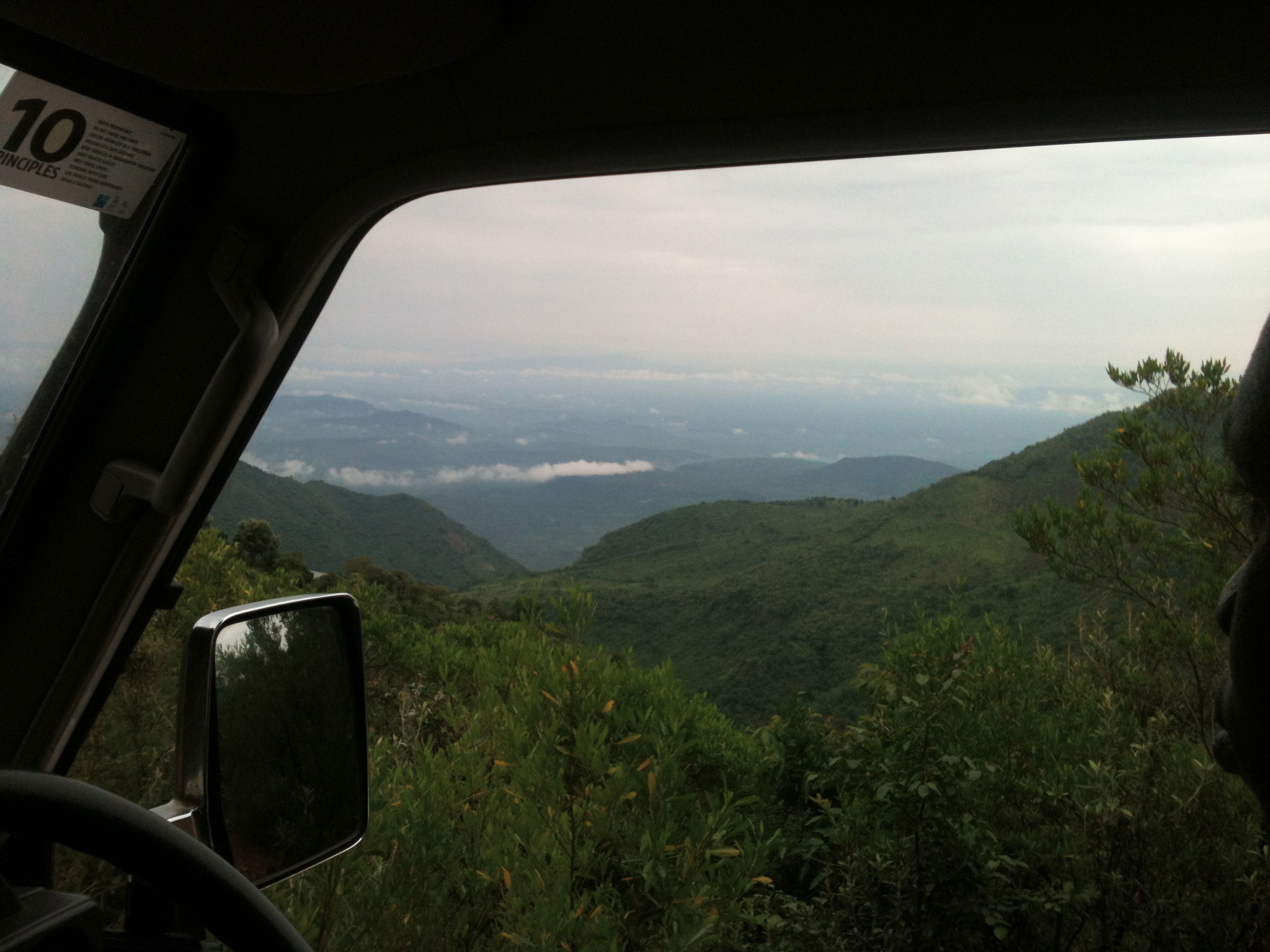
I live in Seattle where a view like this would cost you millions. But Lazaro and his family look at the Great Rift Valley from a thatched hut with mud floors. So maybe here is a good place to help, and maybe find out just how much one child’s life is worth.
Two tall lattes a week? Sure.
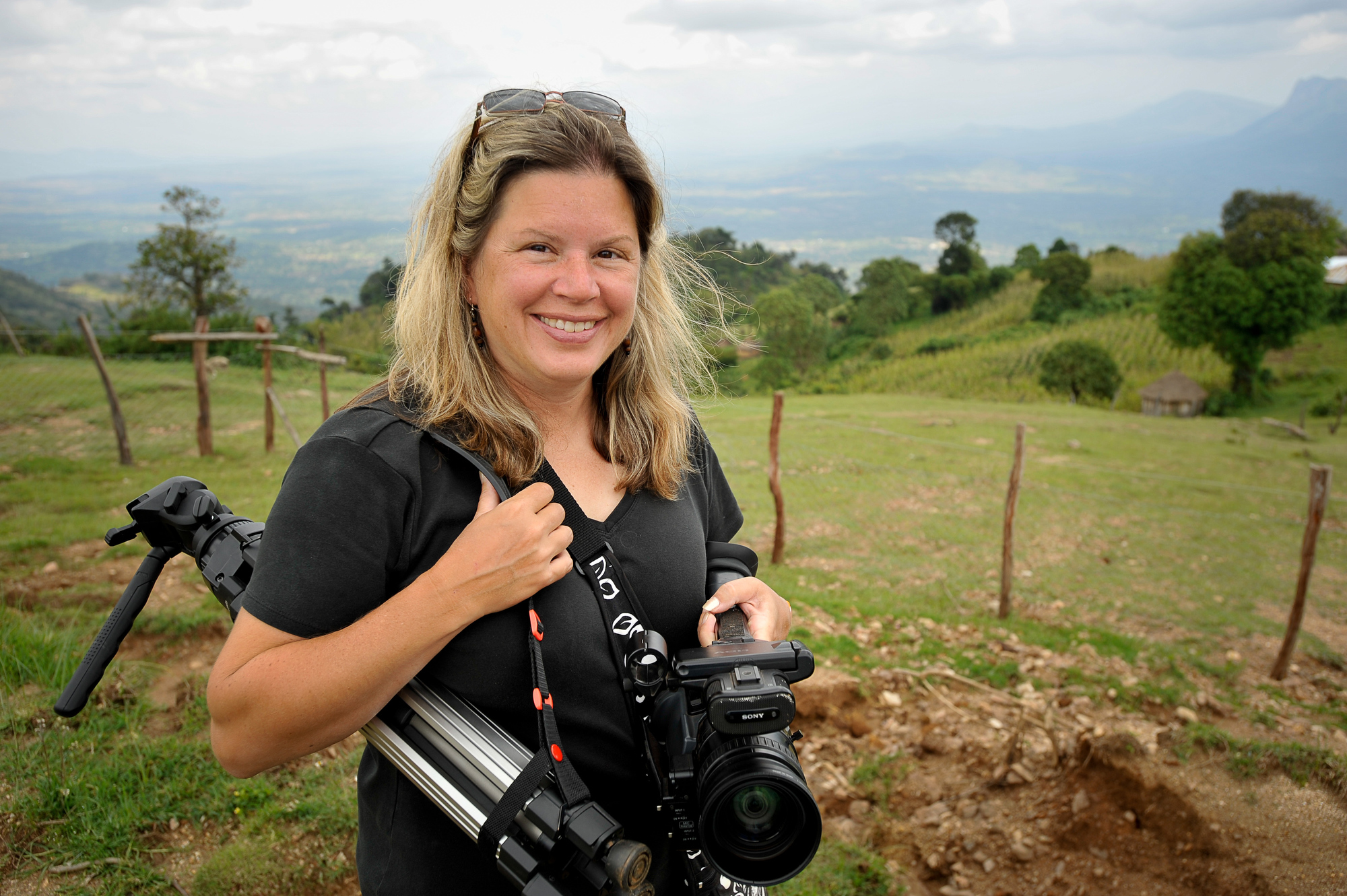
Kari Costanza
On Assignment – Kenya
Kari Costanza’s Tips for the Re-purposed Journalist
1. It’s not about you.
2. Don’t do it if you don’t truly like people
3. Be prepared for a joy and a pain that you could never imagine when you were studying to become a journalist in school.
After graduating from the University of Washington, Kari held a job as news producer at KIRO 7 TV and at several stations on the East Coast. As a producer, Costanza says, “I shaped and wrote much of the newscast. I worked with anchors, reporters, photographers and production staff to condense the news of the day into a 30 minute broadcast.”
Costanza met that daily deadline for ten years. Then one day she remembers a KIRO 7 TV colleague, Tony Ventrella walking by her newsroom desk and whispering, “You’re not happy. You need to make a change.” The words haunted her because they rang true.
It was spring, 1995.
Then her mother cut out a news article in her hometown paper, the Tacoma News Tribune about how a Christian non-profit called World Vision was moving from Southern California to Federal Way. In June she was hired.
She has never looked back.
In the first five years after joining the World Vision video department, Kari produced 300 videos. She became Managing Editor of World Vision Magazine in 2000. In 2010, World Vision International asked her to be Global Editor. Today, Kari Costanza is Editor of Special Projects and Content Curation. In 17 years with World Vision, Kari Costanza has been to 40 countries.

Kari Costanza
in Turkana, Kenya
“The hardest part is when you care about people and they die, ” says Costanza. “We did this story in Rwanda in August. We’d heard that 10 people had died in a refugee camp.” As always, Costanza wanted to personalize the story. At a hospital near the camp, she met a woman named Solange who had lost a daughter since moving to the camp from the Congo. She and NPPA Photographer of the Year Lisa Berglund produced a video of Solange and her baby, Esther when they came back from Africa. “But then, after we left Rwanda, we found out that Esther died. We mourned. I just went into my cubicle and cried,” says Costanza.
“That doesn’t happen in TV news.”
On Thursday, September 20th, at 1pm (Pacific) Kari will join World Vision award-winning photographer Jon Warren for a presentation at Seattle Center as part of the Center’s “The Next Fifty” Celebration called “Approaching The Story.”
Links:
For the Solange story:http://www.youtube.com/watch?v=iciR3jGCiaA
For the One to the World Digital Classroom: http://n50.onetotheworld.net/health12#
This is what a humanitarian looks like.
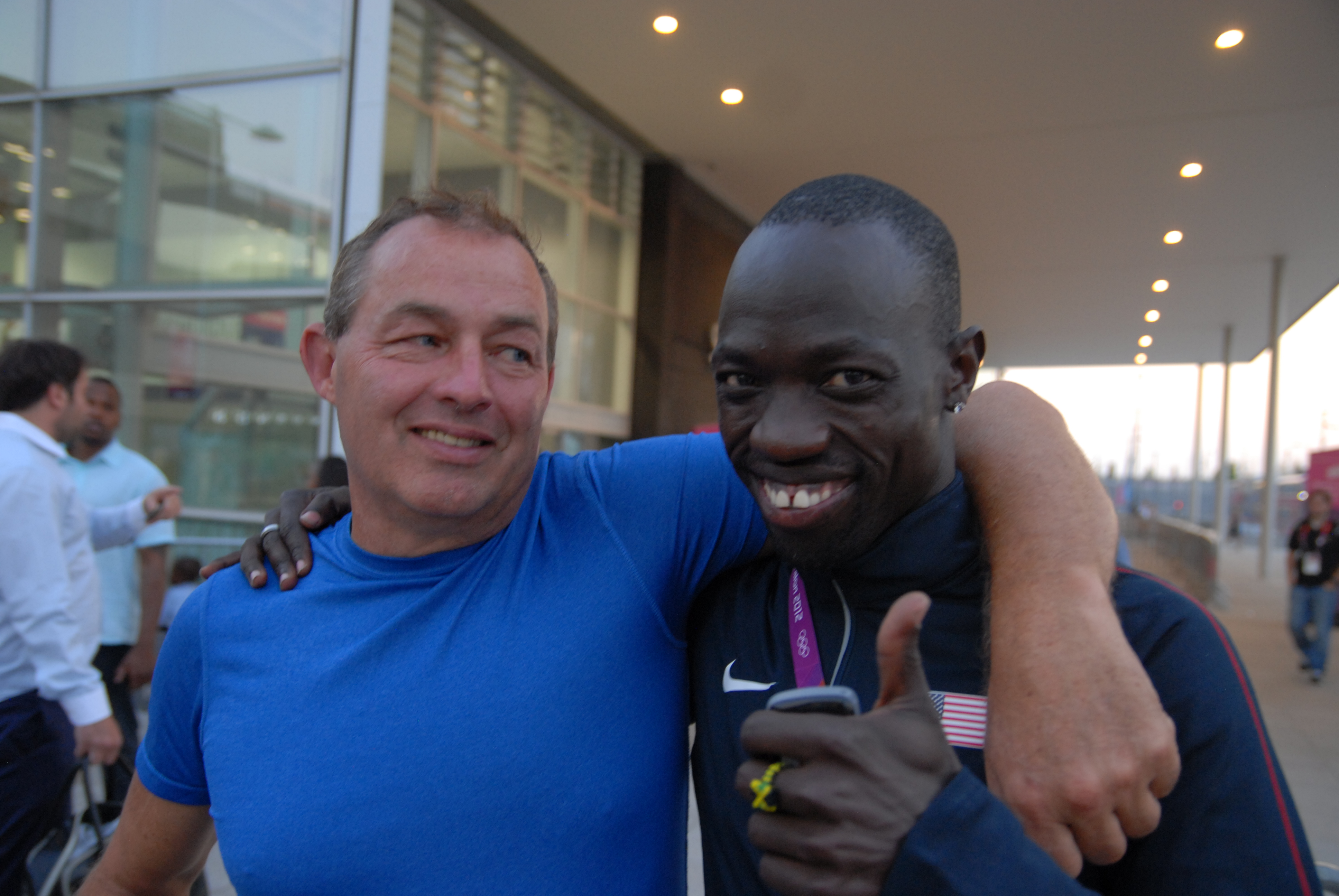
Lopez Lomong (right) Rob Rogers (left)
This Saturday, December 1st, former Lost Boy and U.S. Olympian Lopez Lomong will be awarded the Visa Humanitarian of the Year Award in Daytona Beach, Florida.
The last time I saw Lopez was a few weeks ago in Auburn, Washington when he spoke to more than a thousand in attendance at World Vision’s Day of Prayer. Lopez was recounting all that had happened this year. I remember one night in particular, the night before the biggest race of his life. And he was smiling.
The race was the men’s 5,000 meters on Saturday at the Summer Games in London. He was surrounded by some of the most important people in the world to him, his girlfriend, Brittany Morreale and his mother and father, Barbara and Rob Rogers from Upstate New York. Barbara kept quietly repeating, “I’m so proud of him.”
In 2001, she and Rob brought Lopez over to America from a refugee camp in Kenya. At the age of six, Lopez was abducted by Sudanese rebels and taken to a holding facility where he was prepped as a child soldier. It was determined he was too small. Chances were that he would have been left to starve to death but three fellow captives, his “angels” as he describes them, helped him escape. After three days and nights Lopez was captured by Kenyan soldiers taken to that refugee camp where he lived for ten years, until the Rogers adopted him.
Soon they discovered he was the fastest kid in school, then the state and one of the fastest in the nation. He qualified for the US track and field team in 2008 and was the flag bearer for the Beijing Summer Games. Four years later, Lopez Lomong is at his second Olympics. Rob Rogers says in 2008, “It was like a dream.” But this time his dad says, “he’s here to win a gold medal.”

Michael Chitwood (Team World Vision) on left
That’s what his family and Team World Vision friends including Josh Cox prayed for.
Josh Cox (left) Michael Chitwood Team World Vision (right)
Cox is a long-distance runner, the American record-holder in the 50K and a four time U.S. Olympic Marathon Trials qualifier. Team World Vision is a fundraising program of international Christian charity World Vision that equips individuals to raise money for World Vision projects. Lomong’s 4South Sudan is a World Vision partner committed to finding clean water, health care, education and nutrition for kids back home in South Sudan.
http://lopezlomong.com/foundation/

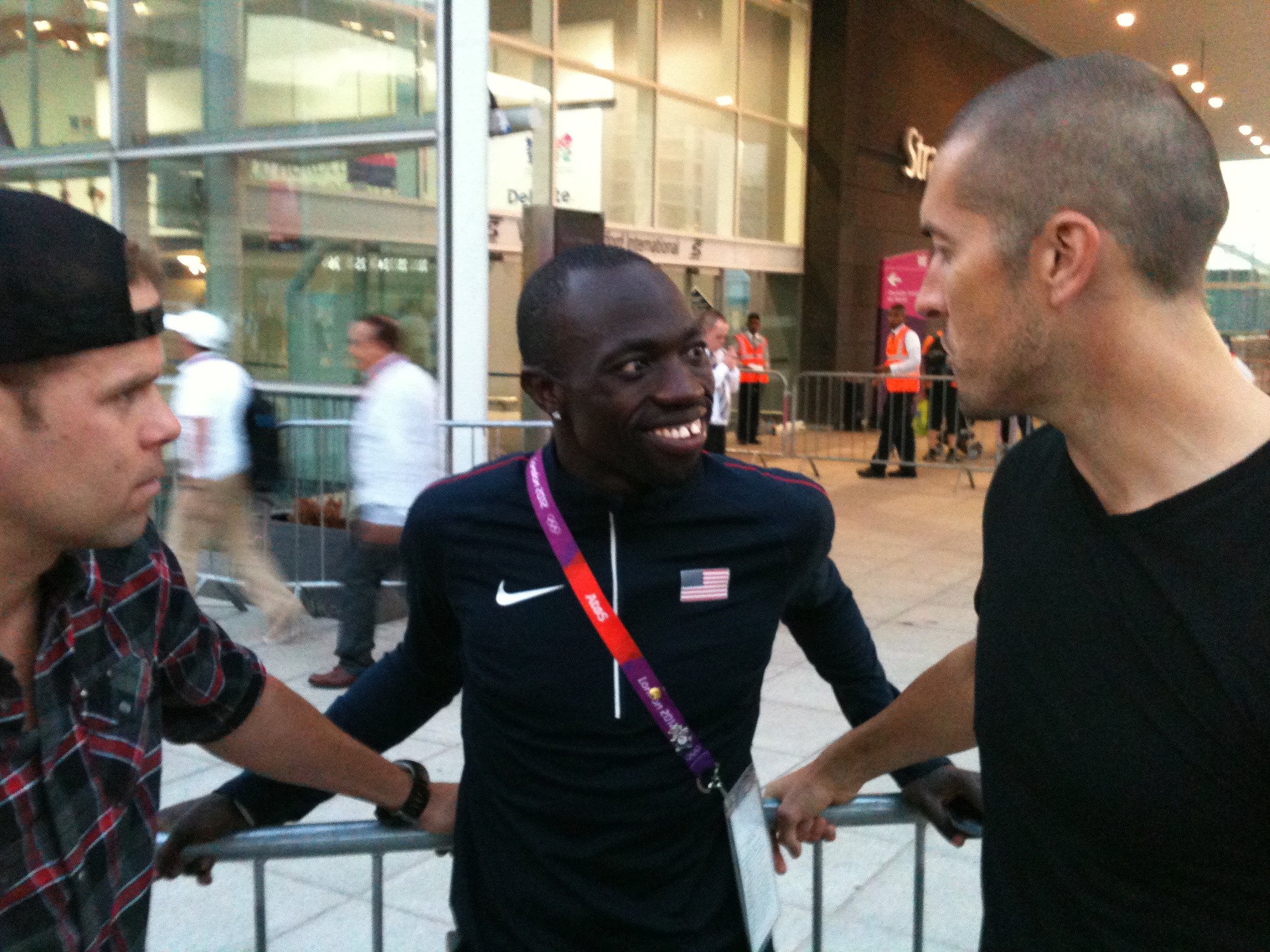
me (on left) with Lopez
I was in London with Cox, Team World Vision National Director Michael Chitwood and Team World Vision’s Steve Spear. We were all there to cheer Lopez on. The next night he ended up finishing tenth in the race after leading as he headed into the last lap. A disappointing finish but not a demoralizing one. “I’ll be back,” he told me after the race. “I learned a lot this time around. I’ll be back.”
I thought about that response when I heard that Lomong had been honored as Visa’s 2012 Humanitarian of the Year. And I thought about the commitment Lomong has made to helping children back home and here in the States through his work with Team World Vision.
Something tells me he will be back. But then – something tells me he’s never left.
Thursday, December 6th, Lomong will travel to the Bay Area where he’ll run with at-risk youth in Oakland. That weekend, he’ll run in a half-marathon in Walnut Creek, California for Team World Vision.
Lomong’s new book is called “Running For My Life” (Thomas Nelson Publishing)
 the repurposed journalist