
2
Monday night, new media guru Drew Keller discussed the ideas of “Norms of Reciprocity” in the digital world. Graduate students in the Master of Communication Digital Media program on the University of Washington campus like me always take something valuable away from open and free discussions that Keller initiates.
But this topic hit close to home. Simply stated it’s give, then take.
And that seems to be the operative norm alive in new media today. Having an agenda is fine as long as you put others first. Sharing is the key word today. “Publish then filter” is what Clay Shirkey writes in “Here Comes Everybody.” Put it out there and see what happens. It’s the discussion that matters.
Keller told us if you “do something nice for a human being” they tend to feel gratitude and that drives the desire to reciprocate. This is much like “it’s better to give than receive” motto that Christians try to practice as well. We think about it but all too often fail to practice it at Christmas. Still, it’s a good rule of thumb in today’s every-changing and technologically complex world.
On Monday, I posted a blog about Lee Schneider, a new media documentary producer and blogger for the Huffington Post https://johnallenyeager.wordpress.com/2012/04/09/lee-schneider-the-goal-is-to-build-something/. I write about people like Schneider because they give back. Schneider is using his skills as a storyteller to actually help get things built. His upcoming documentary project will be targeted to community activists and architects (and you) in an effort to build consensus and hopefully … buildings, the foundation of shelter in Haiti (and perhaps domestically in a city like Detroit).
Not ironically, Schneider’s project is called “Shelter”. Check it out http://docucinema.com/shelter/. It’s a journalist giving back as he builds consensus and a growing viewership. Schneider will get people to watch because he’s a gifted national storyteller with network news credentials. But his giving spirit just might get you to give.
Given then take. Reciprocity.
Seattle to Uganda: A Journey of Hope and Health
The Seattle Channel invites you to a public screening of a new documentary “Seattle to Uganda: A Journey of Hope” which follows local women on an inspiring trip to a small village in Northern Uganda. It’ll be shown Sunday, April 15th at 4pm.
In the fall of 2010, Seattle resident Maureen Brotherton invited 10 women—most of them unknown to each other – to join her on a journey to visit the women in Aminocira, Uganda. Seattle documentary filmmaker Penny LeGate followed along as women from opposite sides of the globe “forged a partnership that continues to inspire awareness, social change, health opportunities and hope for a better future.”
The free, public screening of the half-hour documentary will take place at Seattle University’s Wyckoff Auditorium, Bannan Engineering Building, 901 12th Ave. Brotherton,
LeGate and several of the women will reunite for the preview and a post-screening talk.
The Community Stories series is about the inspirational people, the relevant issues and the cultural traditions and rich histories that make up our many communities. These short television profiles highlight our residents through stories consisting of personal interviews, slice-of-life episodes and insightful portraits. The series has won several local Emmy awards.
To attend, RSVP to Lori Patrick at lori.patrick@seattle.gov or (206) 733-9764.
Lee Schneider: The Goal is to Build Something (and now the Kickstarter.com link is live)
Posted: April 9, 2012 in journalismLee Schneider is headed back to Haiti.
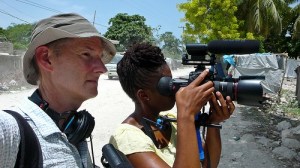
And now Schneider, a documentary producer, is officially launching a campaign on Kickstarter.com to raise money for the return trip where he plans to continue shooting for an upcoming documentary focusing on architects and how good design helps the homeless and victims of disasters (like those recovering from the January, 2010 earthquake) in Haiti.
Here’s the link: http://www.kickstarter.com/projects/docuguy/shelter-return-to-haiti?ref=live
His production team is also researching stories in Detroit with the hope of filming there as well, after Haiti production is complete. This Re-purposed journalist is hoping to reach three target audiences: architects, community activists…
And you.
Lee is a former producer for the ABC News (Good Morning America) and NBC News (Today Show, Dateline) and National Geographic among others. Schneider has always been a passionate journalist who sought to observe and report, to comfort the afflicted and afflict the comfortable and remain objective. But as a re-purposed journalist, Lee Schneider now wants his work to help move the ball down the field. In this case – he wants this documentary to actually help get something built.

When he arrives in Haiti, Schneider will focus on stories and profiles he has researched for the past year. When he moves on to production in Detroit, he says he’ll be looking for projects akin to those underway at The Alley Project (TAP) https://www.facebook.com/tapgallery, a collaborative community “design for good” project where architects and community activists donate their time to design and build neighborhood projects.
“When I worked at NBC I was working for GE. That’s what I stood for. When you work for Nat Geo, (owned by Fox) you stand for Rupert Murdoch.” Schneider, a veteran of NBC Dateline, Fox and ABC’s “Good Morning America” is now directing Shelter http://docucinema.com/shelter/, His documentaries have aired on History Channel, Discovery Health Channel, The Learning Channel, Bravo, Food Network, Court TV, ReelzChannel and A&E http://www.linkedin.com/in/leejschneider.
Schneider also writes a blog for Huffington Post and does online strategies for businesses with a socially responsible mission. His production company http://www.docucinema.com/about/ creates “cause-driven” nonfiction films.
He’s been blogging since 2009. He started by writing a blog called, “500 Words on Thursday”. He averages 2-3 blogs a week. He blogs about once a month for the Huffington Post http://www.huffingtonpost.com/lee-schneider/participatory-design-in-d_b_1340633.html.
Sure, Lee Schneider admits it’d be nice if a show like NBC Today Show ended up doing a story about community renovation in Haiti as a result of the awareness he’s helping create, but he says, “The goal is to build something.”
Schneider’s hoping the Shelter doc will air next year.
They see, they feel, they shoot, they share.
Michael Strangelove writes in “Watching You Tube: Extraordinary Videos by Ordinary People” (University of Toronto Press, 2010) that, “what was once a simple situation of common patterns, local realities, closed audiences and naive epistemologies is now a complex field of globalized cultural production.”
He was contrasting that which went on during the era of the home movie with that which goes on today in the You Tube era.
Without knowing it, Strangelove was referring to the nieces of a good friend of mine. She talks about them all the time. They are three girls, aged 11, 8 and 6 and they produce home-made videos almost weekly. If they’re inspired by a a movie trailer for “Hunger Games” for example, they’ll shoot a video about it (assuming characters in the film) on an i-phone, edit separate pieces together and share it with family. Call it an “instant home movie”.
You can see this kind of stuff on Facebook and You Tube every day.
Thirty years ago, if you had a home movie camera and you were struck with an idea and shot it on a Super 8mm film, it was a long process. By today’s standards it moved at a glacial pace. If you don’t remember that era you may remember Steven Spielberg’s recent nostalgic thriller “Super 8”. In that movie, the main character shoots his movie on a 8mm film and has to wait almost a week for the film to be “rush” developed.
That slow process (the old homogeneous patterns of traditional home movie making) effected the nature of the content. It took more time to tell the story. Back then, you had to wait. The process could often take weeks from initial idea to screening. And then you needed a projector and a screen.
With the advent of the home VHS (or Beta), after you shot something you could watch the “home movie” if you sat down around the TV. It was linear. It wasn’t edited. It was family. It was archival. It was personal.
Today’s home movie makers can share their work with a bigger “family” (You Tube viewers). The content doesn’t have to be linear. It can be edited. It may or may not be family. It most certainly will be archival. But I wonder, given the ubiquity and reach of You Tube – just how personal it is.
Maybe I’m old school but the emerging norms herald a different mindset. I’m not sure for example, if I’d want to share i-phone video of a child’s birth with the “whole world” seconds after it happens. Too personal. I need more time to contemplate. And I’m not sure anyone would care how I choose to relate to “The Hunger Games”…
But don’t tell that to my friend’s nieces. They see. They feel. They shoot. They share. Now. And for them it is personal and a whole lot of fun. Rumor has it they’re shooting another one …
Now.
You can celebrate the advent of citizen journalism in social media all you want but at the end of the day – someone still needs to decide where the story lives and more importantly – what a story is. Otherwise it’s just fragments of a story, remnants, slices.
In discussing Michael Strangelove’s “Watching You Tube: Extraordinary Videos by Ordinary People”, I’m struck with the fact that the line is blurred between producers of video and consumers of video. And to prove the point I have to look no further than my own career.
Once upon a time (when I worked in news) a tour was a big deal. Visitors would love to see the high-priced professional cameras we used. It used to be standard for video gear to run $60,000. Last week, I just bought a Canon XF100 for $3,000.
The bar for entering the video club is a lot lower than it used to be. My hope is that the quality of content isn’t cheapened. My hope is that I’ll always set my own bar and that it’ll always be higher.
Stay tuned.
Sometimes less is more. In fact, when you sit down to write – it’s always more. Wise words from the front thanks to KGO’s Wayne Freedman in San Francisco.

As this re-purposed journalist navigates his way up the steep, short hike of life, he’s wondering if you share his fascination and distaste for You Tube. Am I alone?
Do you You Tube? More than two billion of us watch You Tube every day.
YouTube streams 4 billion online videos each day, more than one for every other person on Earth and a 25% jump over eight months ago.
http://mashable.com/2010/05/17/youtube-2-billion-views/
In “Watching You Tube: Extraordinary Videos by Ordinary People”, author Michael Strangelove examines the You Tube phenomenon. New media guru and MCDM instructor Drew Keller has assigned it as this week’s reading in his COM 583 Storytelling class on the University of Washington campus.
Keller’s questions:
What do you think happens to the social order if tastes are no longer closely controlled by institutionalized influences? or How would you describe the complex relations between producers and consumers?
The answer to the first question is simple – You Tube, the natural by-product of a relaxation of the institutional influences of broadcasting. As newsrooms across the nation continue to cut back in hours of programming, You Tube claims that twenty hours of video are uploaded to its servers every minute.
Twenty hours – one minute.
That’s roughly as long as it’s taken you to read from the top of this post to this point. Twenty hours of video. What’s popular? Charlie Bit My Finger http://www.youtube.com/watch?v=_OBlgSz8sSM (with more than 438 million views).
This may sound old school but in the age of You Tube, high quality storytelling (visual journalism) in this country seems to be eroding. I use this blog to celebrate those who keep its purpose alive. You can also find their work on http://www.facebook.com/groups/TVNewsStroytellers/ This is where you can see broadcast television storytellers like John Larson, Boyd Huppert, Wayne Freidman and John Sharify (to name jut a few) share their excellent craftsmanship with peers. This Facebook page is where journalists seek the recognition and approval of peers they respect. These are the best of the best.
It’s a page where you’ll never see “Charlie Bit My Finger.”
But Strangelove says, “We are moving into a post television era”, adding that You Tube “demands our attention, fragments audiences, worries advertisers, troubles TV execs and erodes monopolization by media corporations.” His insights into the You Tube phenomenon move the ball down the field.
You Tube levels that playing field.
It breaks down the barriers between producers and consumers. It gives anyone with a mobile phone a chance to post a video or picture. But capturing a lucky moment with two boys in a chair is one thing – crafting a story with purpose and style and direction under deadline is something else.
God bless England’s Howard Davies-Carr, the father of the boys, for being there to capture a special, honest moment with two boys on a chair sharing a moment but he’s not a journalist. He’s not a storyteller. For that you need to spend years honing your craft and refining your talent, seeking feedback from those you respect.
For that you need a purpose. It’s the crafting of a story.
So for me, we’ll always need places where the barriers between producers and consumers exist. Strangelove quotes French sociologist and author Henri Lefebvre, “The everyday is what’s left over after all distinct, superior, structured activities have been singled out.” http://www.youtube.com/watch?v=CiHfntd7jIs. You can find Lefebvre on You Tube. The video is 9:27 long. It’s in black and white and all in French. It still has more than 15,ooo views.
Bottom line – it is the role of the storyteller to distill the “everyday” and make it memorable. Life still needs some translation. We can all see a sunset. But not everyone can find the words or the pictures to capture it and bring it back home.

Incidentally, I took that photo with my i-phone. I’m thinking of posting it to You Tube 😉
A Re-Purposed Journalist comes home and brings back video. This just in from KING 5’s Margaret Larson and her recent trip to Africa.
http://www.king5.com/new-day-northwest/Margarets-Africa-Update-143481446.html
KING 5’s Margaret Larson is home again.
Larson has just returned from Africa and says, she’s “very excited about the progress of our on-the-ground partners.” Larson tells me what she saw over in Africa was “very moving and enlightening” as she learned more from families there about what cancer is like in their world, especially for children.

The New Day Northwest host has a simple question, “How much would you spend to save one African child’s life?” Larson has found the simple answer – around $450.
Samuel, a boy in the Burkitt’s ward at a hospital in Kisumu, Kenya 2009.

Larson says cancer kills more people worldwide than AIDS, tuberculosis and malaria combined, adding that it’s not just an African problem. “It’s a global issue”, she says. But Africa is where her new non-profit volunteer work for Burkitt’s Lymphoma Fund for Africa (BLFA)
Margaret Larson with Burkitt’s patient, Rosemary and her aunt – March, 2012 – Kisumu, Kenya
http://blfundafrica.org/ is taking place. It’s also where a journalist like Larson, 54, has found a new purpose. http://www.guardian.co.uk/global-development/poverty-matters/2011/feb/04/cancer-africa-health-burden.
“The problem”, says Dr. Corey Casper, of Seattle’s Fred Hutchinson Cancer Research Center, (referring to Africa) is that cancer is still perceived as too expensive to treat. Some childhood cancers, such as Burkitt’s lymphoma, cost as little as around $500 to cure, with success rates of 95%. It costs $300 per month for life to keep someone on ARVs (the drugs used for HIV), so a one-off, $500 to treat a child seems like money well-spent.” Larson says the international community also dictates the agenda to a certain extent. Uganda receives $200 million annually from the United States for HIV treatment, but less than a $1 million for cancer. The Hutch is an active partner with BLFA.

Margaret Larson has hosted New Day Northwest on KING 5, since March, 2010. Seattle is the nation’s 13th-largest media market.
From 1992 to 1993, Larson hosted NBC’s Today Show and worked as a correspondent for NBC Dateline. She also anchored at Seattle’s KIRO TV from 1994 to 1997.
Larson has been doing non-profit work since 2004 when she served as VP of Communications for Portland-based Mercy Corps http://www.mercycorps.org/.She’s also done work for Federal Way-based World Vision http://www.worldvision.org/, Seattle’s PATH http://www.path.org/ and Global Partnerships http://www.globalpartnerships.org/. But she says, “I’ve always been speaking for someone else.”
At BLFA, where she serves as a member of the Board of Directors, she says, “This is the first time I’ve had a chance to vote on decisions about mission, finances and accountability as opposed to simply being a freelancer who’s consulting or creating a video. It’s about saving the lives of little kids.” Larson says 100 percent of what people give goes to program, to funding treatment.Larson says the other BLFA board directors are business executives, medical experts, financial minds, “and me, a communicator.”
BLFA started after a PATH trip to Kenya in 2009. Larson visited a hospital commissioned by former U.S. Senator Barrack Obama, in Kisumu, Kenya, near Obama’s father’s hometown. At the hospital, Margaret saw “dramatic” tumors, the result of Burkitt’s Lymphoma, a form of cancer very rare in the United States. Symptoms are tumors in the head and jaw area and sometimes in the abdomen. It’s the most common form of childhood cancer found in Africa. “The thing that stunned us all”, recalls Larson, “is that we were told that all the kids we saw would die, every one of them, in a matter of weeks. And yet it’s completely treatable.

Her inspiration in this venture, Seattle’s Miriam Sevy, who was also in the hospital that day. Sevy is the creator and now President of Burkitt’s Lymphoma Fund for Africa, http://www.youtube.com/watch?v=C7zP7Fv_rpg, and a high-level financial consultant. “Miriam just thought of her own son, Adam and that was that.”

“Burkitt’s Lymphoma Fund for Africa is about educating physicians and caregivers in Kenya, Uganda and Tanzania, funding treatment and removing barriers to family’s seeking ” says Larson. She’s over there in sub-Saharan Africa right now, checking on how money’s being spent and how well goals are being met.
BFLA member Miriam Sevy with young friend, Nairobi 2009

Larson with Erica Sessle from Seattle’s Fred Hutchinson Cancer Research Center Uganda, March 2012. Hutch program received a grant from BLFA
“Sometimes it feels like you’re pushing a rock up a hill when you think about the challenges in the world. You see these problems are so big but this project represents something I can do.” Now, she says, “I have a sense of ownership that I hope will last the rest of my life.”

Larson with recent guest, World Vision’s Michele Tvedt from 30 Hour Famine.
“At my core, I’m a foreign correspondent,” says the former NBC Nightly News and NBC Dateline correspondent.“It’s what I wanted to do when I was little,” says Margaret. “As a journalist,” she says, “it matters to us what’s true. But often we fail to apply it to ourselves. When I was in news, Larson says, “My inside and my outside didn’t always match.” Doing this work with BLFA is, “me matching my inside and my outside.”
Larson says there are probably two ways to grow the organization; major gifts and grants or donations (like Girl Scouts or PTA’s). So far Larson says they’ve gone after major gifts. But Larson is also using the popularity of KING 5’s New Day Northwest http://www.facebook.com/margaretlarson.newday, Margaret explains the simple ‘ask’. “Send us a hand towel and a bar of soap and we’ll make sure someone gets it.” Viewers wrote notes to African children living with Burkitt’s Lymphoma. “The goal was to give viewers something they could do. It was a ‘my hand to your hand’, thing.” That, she says, “was crucial in creating a meaningful connection.”
Larson is posting from the New Day Northwest’s Facebook page http://www.facebook.com/margaretlarson.newday and sending back video from Africa. KING 5, she says has ‘bought in’. The time to take the trip was written into her KING 5 contract. “I didn’t want to give international volunteer work up,” says Larson. She adds, “management gets that.”
Larson says BLFA is an exhilarating project. As for being a “re-purposed” journalist? Margaret Larson says “Re-purposing isn’t recycling. I’m finding my new purpose. And I feel a lot smarter today.”

Margaret Larson’s Tips for Re-purposing Yourself as a Journalist:
1. Find out what you really care about.
2. Find something that has permanence.
3. Don’t underestimate your skills like critical thinking.
Posted: March 15, 2012 in employment, journalism
 the repurposed journalist