This is what a humanitarian looks like.
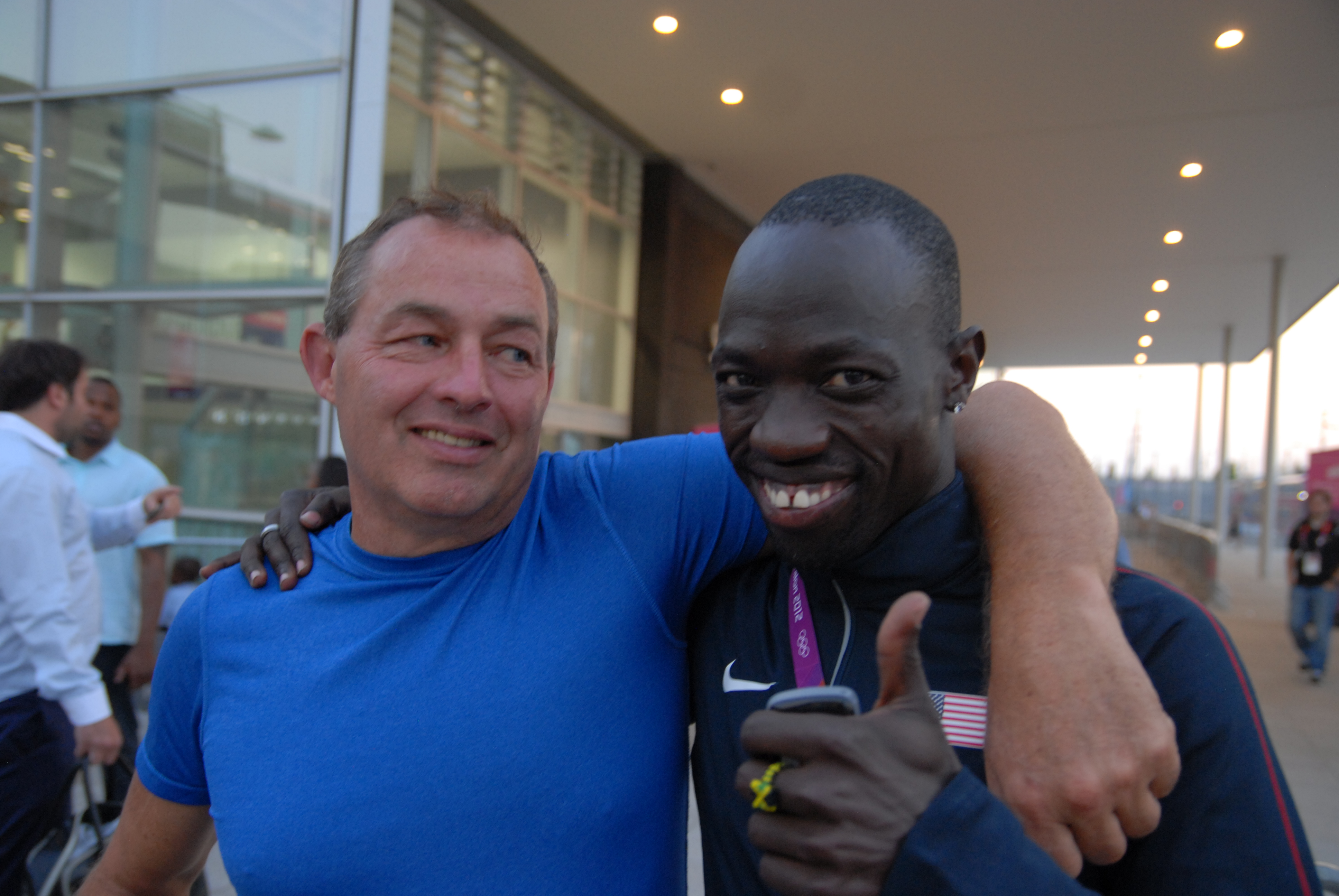
Lopez Lomong (right) Rob Rogers (left)


This Saturday, December 1st,  former Lost Boy and U.S. Olympian Lopez Lomong will be awarded the Visa Humanitarian of the Year Award in Daytona Beach, Florida.

The last time I saw Lopez was a few weeks ago in Auburn, Washington when he spoke to more than a thousand in attendance at World Vision’s Day of Prayer. Lopez was recounting all that had happened this year. I remember one night in particular, the night before the biggest race of his life. And he was smiling.

The race was the men’s 5,000 meters on Saturday at the Summer Games in London. He was surrounded by some of the most important people in the world to him, his girlfriend, Brittany Morreale and his mother and father, Barbara and Rob Rogers from Upstate New York. Barbara kept quietly repeating, “I’m so proud of him.”

In 2001, she and Rob brought Lopez over to America from a refugee camp in Kenya. At the age of six, Lopez was abducted by Sudanese rebels and taken to a holding facility where he was prepped as a child soldier. It was determined he was too small. Chances were that he would have been left to starve to death but three fellow captives, his “angels” as he describes them, helped him escape. After three days and nights Lopez was captured by Kenyan soldiers taken to that refugee camp where he lived for ten years, until the Rogers adopted him.

Soon they discovered he was the fastest kid in school, then the state and one of the fastest in the nation. He qualified for the US track and field team in 2008 and was the flag bearer for the Beijing Summer Games. Four years later, Lopez Lomong is at his second Olympics. Rob Rogers says in 2008, “It was like a dream.” But this time his dad says, “he’s here to win a gold medal.”

Michael Chitwood (Team World Vision) on left

That’s what his family and Team World Vision friends including Josh Cox prayed for.
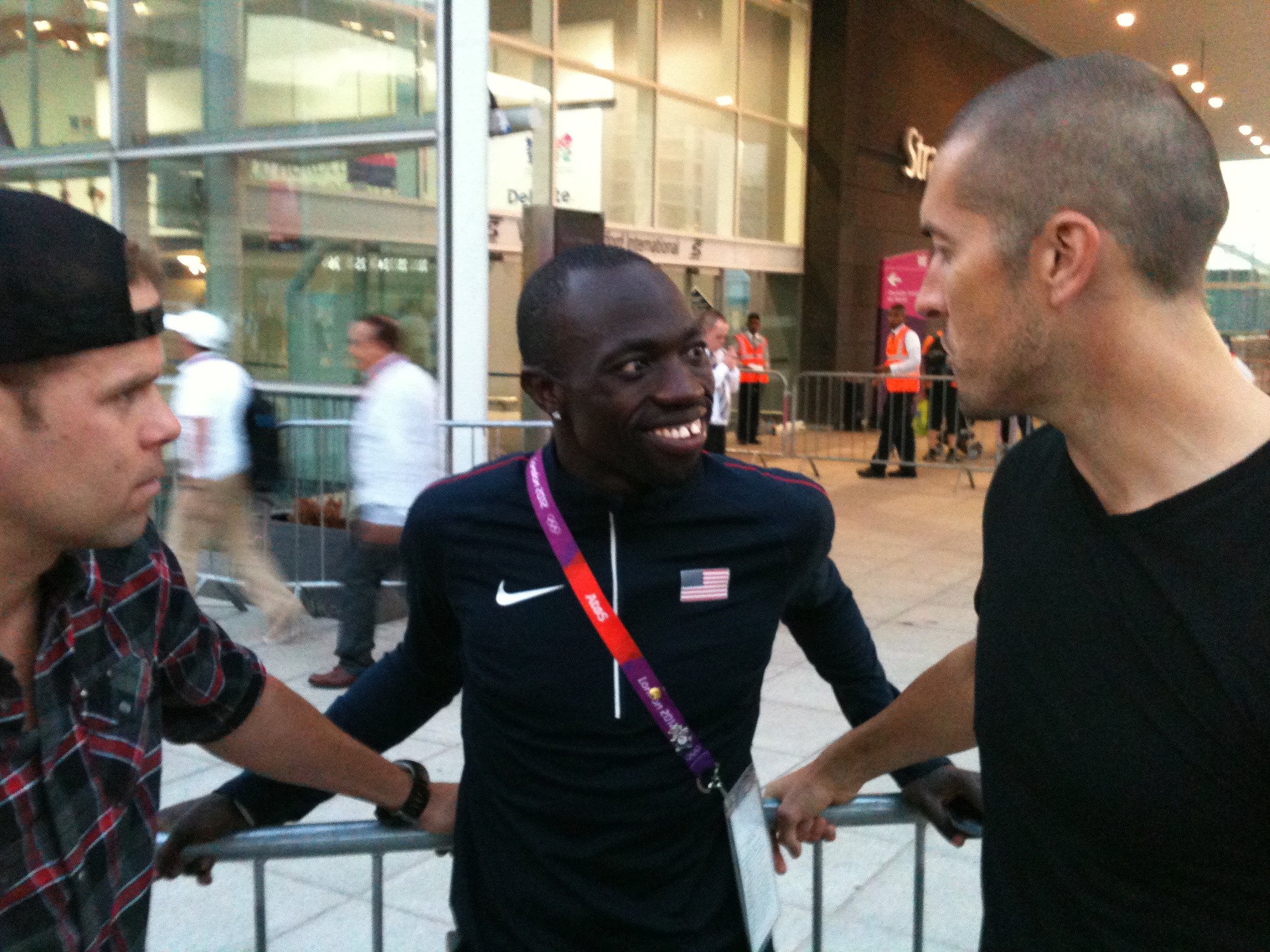
Josh Cox (left) Michael Chitwood Team World Vision (right)

Cox is a long-distance runner, the American record-holder in the 50K and a four time U.S. Olympic Marathon Trials qualifier. Team World Vision is a fundraising program of international Christian charity World Vision that equips individuals to raise money for World Vision projects. Lomong’s 4South Sudan is a World Vision partner committed to finding clean water, health care, education and nutrition for kids back home in South Sudan.

http://lopezlomong.com/foundation/

me (on left) with Lopez

I was in London with Cox, Team World Vision National Director Michael Chitwood and Team World Vision’s Steve Spear. We were all there to cheer Lopez on. The next night he ended up finishing tenth in the race after leading as he headed into the last lap. A disappointing finish but not a demoralizing one. “I’ll be back,” he told me after the race. “I learned a lot this time around. I’ll be back.”

I thought about that response when I heard that Lomong had been honored as Visa’s 2012 Humanitarian of the Year. And I thought about the commitment Lomong has made to helping children back home and here in the States through his work with Team World Vision.

Something tells me he will be back. But then – something tells me he’s never left.

Thursday, December 6th, Lomong will travel to the Bay Area where he’ll run with at-risk youth in Oakland. That weekend, he’ll run in a half-marathon in Walnut Creek, California for Team World Vision.

Lomong’s new book is called “Running For My Life” (Thomas Nelson Publishing)

A Beautiful and Amazing Child

Marah Williams – Ethiopia – March, 2012

Her mother says 19 year-old Marah Williams took care of others in many ways unknown to most of us until her death on June 12, 2012. Marah’s mom is Penny LeGate, a former Seattle TV (KIRO 7) anchorwoman and (KING 5) Evening Magazine co-host. Penny says, “Marah was an extremely intuitive, loving person who shouldered everyone else’s burdens.” LeGate says, “They became part of Marah’s internal fabric, leaving her little energy for her own troubles.”

A few weeks after this March, 2012 photo was taken in Ethiopia, Penny lost her daughter who had battled chemical dependency and depression for years. Marah had accompanied her mom on a trip exploring Ethiopia’s remote Omo Valley. LeGate says, “It’s home to many colorful, indigenous tribes that are rapidly disappearing due to development. Marah’s striking blonde hair, tattoos, and gentle heart guaranteed a cloud of villagers gathered around her, especially the children.”  Mom and daughter had traveled together to other countries such as Vietnam and Nicaragua in years past.  Ethiopia would be the last trip the two would make together.

Penny says one of Marah’s lifelines was Northgate Middle College, an alternative high school which is part of the Seattle Public School system’s safety net program. LeGate says, “These struggling teens who don’t fit into a typical high school environment get individual guidance there so they can get the credits necessary to finish high school.”

Marah (left) her mom (right)

Marah Williams – Ethiopia – March, 2012

In order to support other teens like Marah, Penny, Marah’s father Mike Williams, and sister Molly, want to direct memorial funds into a special account called The Marah Project. It’ll award paid internships to youth selected from the Middle College Program in Seattle. The fund will be managed by Teens in Public Service, an organization with a proven track record of 15 years.  Teens in Public Service provides paid internships to youth in community service jobs.  LeGate says, “The Marah Project will give underserved teens a life-changing opportunity to succeed and also provide support as these often forgotten kids work to achieve their life goals.”

It will also be the way one mom keeps her daughter’s legacy alive.

This link goes directly to The Marah Project:

http://www.teensinpublicservice.org/get-involved/the-marah-project/

Mary Pilon – New York Times

“We don’t like being the story.”

Mary Pilon was emphatic.  But it was a simple request from a humble reporter. Reporters like to tell stories not be stories. No problem. Ok, so this won’t be a post about Mary Pilon. It will however, be an example of how a journalist can re-purpose considerable talent.

Oregon native Mary Pilon has written about everything from the Wall Street to board games to track and field. In December, the New York Times hired her away from the Wall Street Journal. She would now be a sports reporter. At WSJ she’d been reporting on the financial crisis on Wall Street. I got a chance to meet Pilon last week in New York City when I was pitching her on Lopez Lomong, the former Sudanese Lost Boy and U.S. Olympic track star. I told her Lopez was a remarkable young man using the flame of his Olympic story to help the kids back home in South Sudan gain access to the basics like clean water, education and food. I’ve been telling as many people as I can about Lomong because he’s partnering with World Vision, the charity I work for.

Pilon knows the Lomong story.  You have to look hard to find someone who hasn’t heard of the Sudanese Lost Boy kidnapped from his village at the age of six, held captive by Sudanese rebels intent upon turning him into a child soldier. The six-year old was deemed too young and left to starve. But thanks to the help of three other boys (to this day Lopez considers them his “angels”) Lopez escaped the detention center. The boys ran three days and nights until they were captured by Kenyan soldiers and brought to the safety of a refugee camp. After ten years, Lopez was sponsored by an American couple and brought to the States. Soon he discovered he was the fastest kid in high school, then the fastest in the state, then one of the fastest in the nation. In 2008, he qualified for the mens 1,500 meter in the Beijing Summer Olympics. His teammates elected him the U.S. National Team flag bearer.

As you’re guessing by now, the story from here on out is about Lopez Lomong.

Here’s what Mary Pilon wrote about Lopez. It was a Q and A.

http://london2012.blogs.nytimes.com/2012/07/16/q-and-a-with-the-u-s-runner-lopez-lomong/

Lopez Lomong, left, and Galen Rupp running in the finals of the 5,000 meters at the Olympic trials in Eugene, Ore., last month.

Eric Gay/Associated PressLopez Lomong, left, and Galen Rupp running in the finals of the 5,000 meters at the Olympic trials in Eugene, Ore., last month.

Lopez is running in the mens 5,000 meter qualifying heat on Wednesday, August 8th in London. He has his sights set on a gold medal but what makes Lomong unique is that fact that he wants to partner with Team World Vision to help the kids back home in South Sudan.

http://lopezlomong.com/foundation/

Or maybe it’s the new book he’s written, “Running for My Life” (Thomas Nelson Publisher).

http://apperson.blogspot.com/2012/07/running-for-my-life-by-lopez-lomong.html

One last thing: In December, Mary Pilon was named one of Forbes Magazine’s 30 Under 30 for media. She is 26. Currently she is writing a book about the hidden history of the board game Monopoly.

http://topics.nytimes.com/top/reference/timestopics/people/p/mary_pilon/index.html

When Lisa Berglund, former National Press Photographers Association Photographer of the Year isn’t traveling the world and winning awards for her remarkable video (Gold Dog Media) for international charities like World Vision, she’s with two of her best friends: a Golden Retriever named Sugar and a Border Collie named Tai who lives “in the moment.”

Want proof of that? Lisa needed far less than two minutes to  make her case. Watch this.http://www.youtube.com/watch?v=UpcuT0PPoj8&feature=youtu.be

Sunday’s Story: Memes

Posted: June 25, 2012 in journalism

When is a video meme an imitation? When is it an homage? And when is it just a rip off? Fast food for thought.

Thursday’s Story Because

Posted: June 21, 2012 in journalism

If you’re old enough to remember the original premiere of Star Wars back in 1977 you’ll never forget that first shot.

First you hear it. Then the immense Imperial Battleship rumbles slowly across the entire screen. There in the darkness of a movie theatre, the film literally took my breath away. Big screen. Big sound. Big impact. Big wow factor.

Now compare that with seeing a copy of Star Wars on my I-phone. Sure it’s more intimate and portable but it’s something I “monitor”. I don’t experience it the same way. I may marvel at how such a huge image can fit in the palm of my hand but the enormity of that moment just isn’t that same. In the theatre there’s less to distract me but there’s little “wow” factor. Nice but nowhere near the same.

How and where we see a story affects its impact and how we engage the story narrative. Stars Wars was an epic. It’s a blockbuster. Those are big words. No content on my mobile will ever compare.

The medium has a direct impact on how the message is digested. Perhaps the novelty of the I-phone trumps all. Perhaps nothing will ever take the place of the movie theatre. And then again, perhaps it’s just too soon to tell. The medium of the miniature alters my perception of content. And there’s no way to replicate the sound from that first screening in 1977.

Maybe you disagree. Maybe you feel we’ve sacrificed nothing in the quest to personalize and in the process, minimize media. Maybe you feel we’re better off. May that force be with you. You’ll need it.

All I can hear is the pounding of my heart. I can’t see a thing.

A black cloth bag is pulled over my head. I hear gunshots.  Men wearing Army fatigues and ski masks pull me out of a van screaming, “On the ground. Now! Don’t move!”  After just a few minutes of silence, the bag begins to feel hot. I can’t get a cool breath of air. Someone takes off my watch and goes through my pocket for my cell phone. I’m either being robbed or taken hostage – or both. Now the bag is taken off my head. The whole ordeal only took only a few minutes. It felt like an hour.

It was just a drill.

Near Strasburg, Virginia

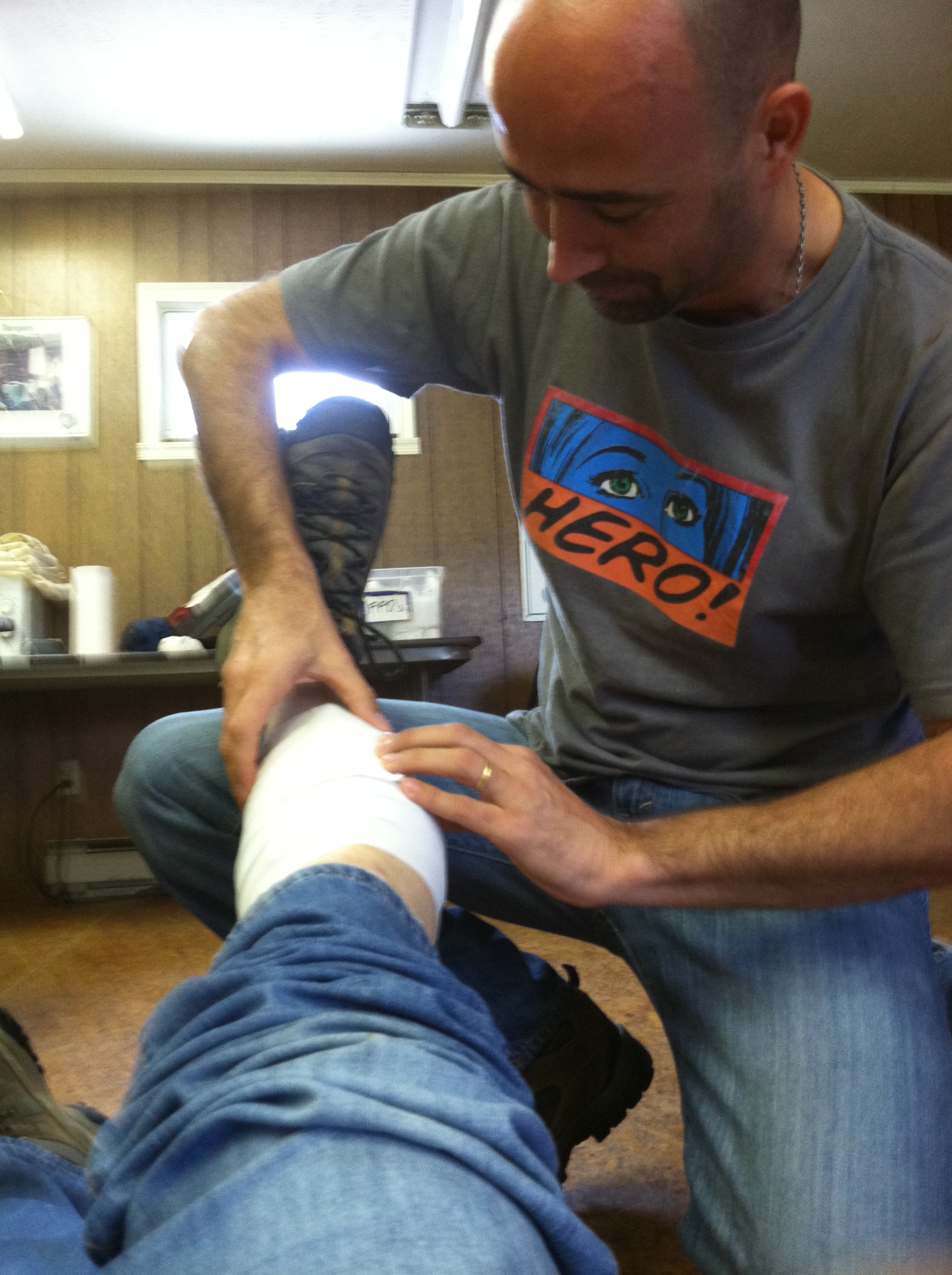
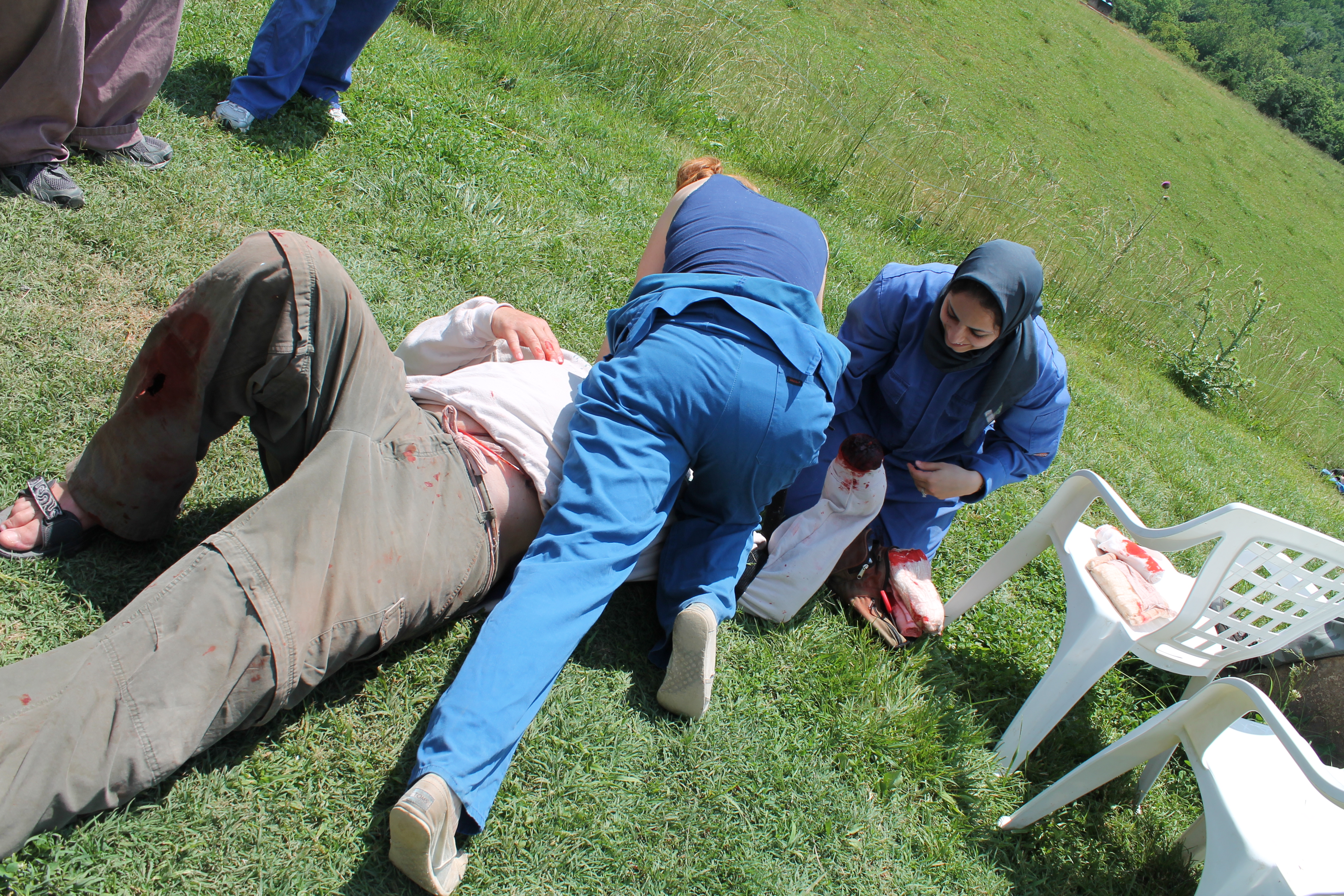
Welcome to Centurion’s Hostile Environment and Emergency First Aid Training Course near the Shenandoah Valley of Virginia. I’m here with a dozen journalists from Associated Press, Al Jazeera (English Language  Channel) and relief workers from non-governmental organizations like mine, World Vision (an international Christian relief and development organization.

The setting is pastoral, a farm near Strasburg, Virginia, near Washington, D.C. But the curriculum is exhaustive, comprehensive and sobering.

The five-day course is designed to prepare journalists and relief workers who may find themselves in hostile environments to fully understand the risks associated with their jobs and to prepare for those risks in realistic scenarios.

For example – you come upon a screaming gunshot victim. How do you respond? Centurion experts told us to determine whether danger still exists at the scene, whether the victim is responsive, identify and stop catastrophic bleeding, check the airway, the breathing and then circulation.

Juan Mayou
Al Jazeera Photographer

We worked on how to treat a wound, a burn or an amputation, spending hours on CPR, how to respond to tear gas, how to negotiate a roadside checkpoint. We even got a primer on how to spot a landmine.

Scott Heidler
Al Jazeera – English
Correspondent

I used to be a full-time journalist, meeting a deadline for more than 25 years covering mountain climbers at Base Camp in the Himalayas and WTO anarchists in the streets of Seattle. In 2005, I found a new purpose by accepting a job to develop stories for World Vision.

Same reporting skills – different purpose. It’s how this blog came to be known as the “Re-Purposed Journalist.”

By the time the five-day course was over, I made some new friends. Nothing bonds twelve people like having a black bag pulled over your head and being forced to the ground. The subject line on our group e-mail says it all:

“Those who get kidnapped together – stick together.”

from left – John Yeager (World Vision), Nahedah Zayed (Al Jazeera), Juan Mayou (Al Jazeera) Holly Frew (World Vision)

But something else happened. Sure they were just drills but I now have confidence in my ability to respond to an emergency. The week also renewed my bond to journalists. If you’re a journalist reading this – just know that I appreciate you a little more today. And maybe I miss doing what you do just a little more too.

That hostage scenario was supposed to me feel what the “shock of capture” was like. Though I couldn’t see – it gave me insight into just how dangerous and unpredictable journalism can be, whether you’re “re-purposed” or not.

Before he became a successful artist, Seattle’s A.J. Power found purpose working in West Africa with the Peace Corps.  Power is among a handful of gifted artists who now find inspiration and a unique sense of community in Building C, described as, “a vibrant community of artists with studios in a former paint warehouse in the Ballard neighborhood of Seattle.”

But Building C is also living testimony to the fact that you cannot judge a book by its cover.

http://www.ajpowerstudio.com/75554/paintings/